Water Damage Questions, Answered
These are the questions people in Houston ask Houston Water Damage 24/7 most often, answered the way the technician would answer them on your doorstep. They cover response, insurance, what has to come out and how drying is judged. If yours is not here, call and ask it.
Rather type than talk? Request a callback online
Every question in one place
How fast can you get to my house?
For active water, the same day, and usually within a few hours depending on where you are in the Houston area and how many calls came in that hour. Tell us on the phone whether the water is still running; if it is, we walk you through shutting it off while the crew drives.
What should I do before the crew arrives?
Shut off the water at the fixture or the main if it is still flowing, and turn off the power to the wet area at the breaker if outlets or cords are in the water. Move small furniture and rugs out of the wet zone. Do not run fans on sewage or flood water. Take photos before anything is moved.
Will my homeowners insurance cover this?
Most policies cover sudden and accidental water damage, such as a burst pipe or a failed appliance, and do not cover flooding from outside unless you hold a separate flood policy. We cannot tell you what your policy says, but we document the job the way adjusters expect: photos, moisture readings, equipment logs and a scope of the work.
How long does drying take?
Three to five days is typical for a room with wet carpet and drywall. Hardwood floors, plaster walls and rooms that sat wet for days take longer. The equipment stays until the moisture readings match the dry parts of the house, and you see those numbers each day.
Do you handle the repairs after the drying?
Ask when you call. The scope of repairs after drying depends on what had to be removed. Either way you get a written list of what came out, so whoever rebuilds has exact quantities.
Can I dry it myself with fans?
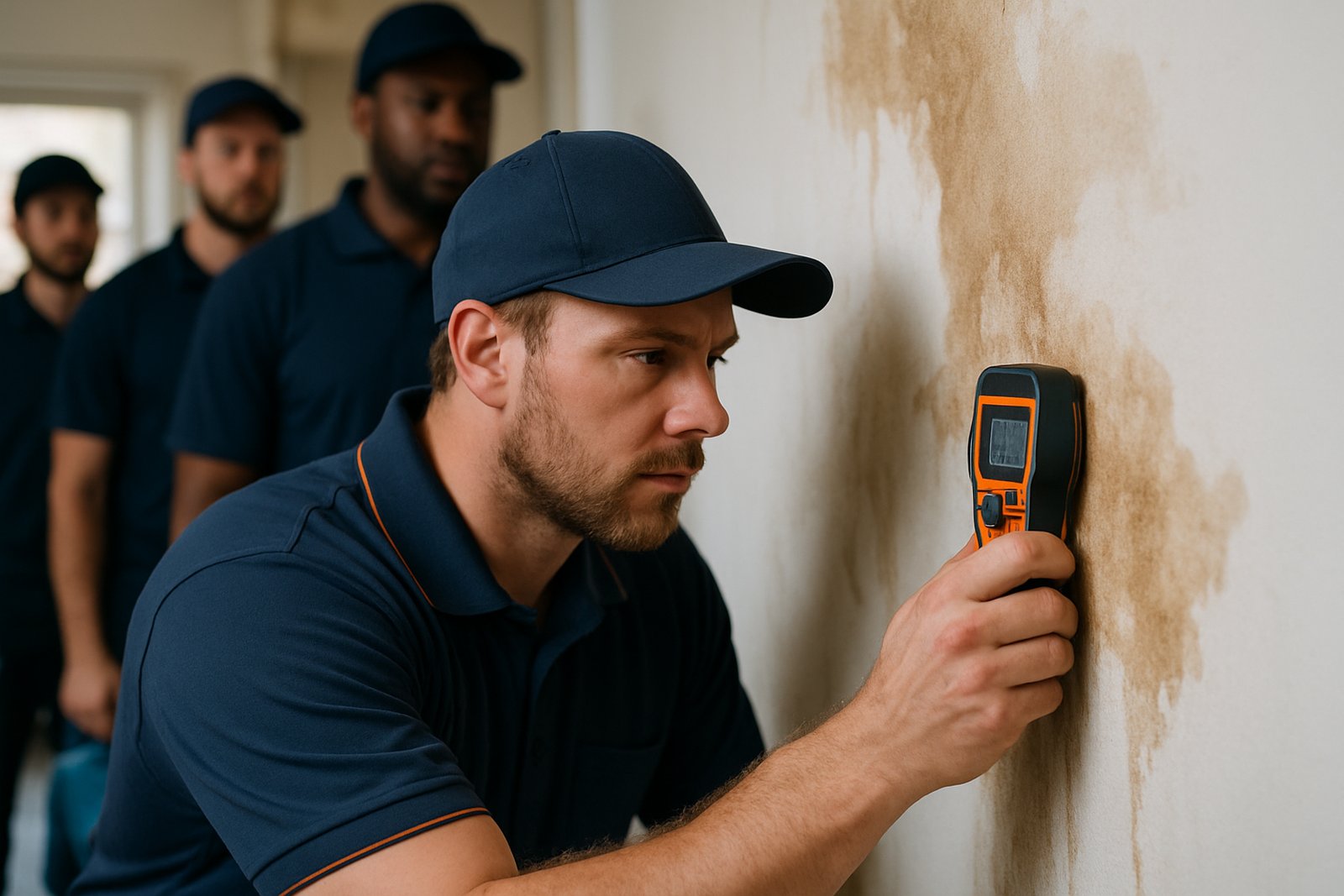
A small clean-water spill on tile, yes. Anything that reached carpet pad, drywall or the underside of flooring, no. Household fans move air over the surface while the water stays inside the material, and mold can start within a day or two. A moisture meter tells the difference, and the estimate visit is free.
How quickly can extraction start?
For active water in the Houston area, the same day and usually within hours. Say on the phone that water is standing on the floor and the call is treated as an emergency.
Can wet carpet be saved?
Often the carpet can, and the pad underneath usually cannot. Clean water extracted quickly leaves the carpet dryable in place with the pad replaced. Sewage or flood water means the carpet goes.
What if the water is still coming in?
Shut off the supply at the fixture or at the main. If you cannot find the shutoff, tell us on the phone and we walk you to it. The crew brings the tools to stop most supply-line failures on arrival.
Do I need to move out during extraction?
Usually not. The equipment is loud, and the wet rooms are off limits, but the rest of the house is livable. Sewage water is the exception; the affected area is sealed off until it is disinfected.
Can I start cleaning up before you arrive?
Turn off the power to flooded rooms at the breaker if it is safe to reach. Photograph the water line and each room. Beyond that, wait: flood water is contaminated, and moving soaked materials without protective gear spreads it.
Do flooded walls always have to come out?
The part that sat in contaminated water does, usually the bottom two to four feet, because drywall and insulation cannot be disinfected. Framing behind it is cleaned, treated and dried in place.
How long until the house is livable?
Removal and disinfection take one to three days for a typical house. Drying runs several days after that. Rebuilding the removed walls and floors comes after the moisture readings are clear.
Do you handle repeated flooding?
Yes, and we will tell you what we see: where the water came in and what would have limited it. Those are observations from the cleanup, not an engineering report.
Do I call a plumber or you first?
Shut the water off first. Then call us; the drying cannot wait for the plumber's schedule, and we can usually cap the failed line so the plumber can do the permanent repair when he arrives.
Is a slab leak handled the same way?
The drying is similar, but finding it is different. A slab leak shows as a warm or damp spot on the floor, a jump in the water bill or a sound of running water. A plumber locates and repairs the line; we dry the flooring and slab, which often means removing the flooring over the wet area.
Will my walls have to be replaced?
Not always. Clean water found quickly can be dried inside the wall with drilled vents and directed air. Drywall that has swelled, sagged or sat wet for days is removed to the nearest clean line.
Does insurance cover a burst pipe?
Sudden and accidental discharge from plumbing is covered by most homeowners policies; the failed pipe itself often is not, and damage from a slow leak that was ignored may not be. We document the job so the adjuster has what he needs; the coverage decision is the insurer's.
How do you know when it is dry?
The moisture meter is compared against readings from unaffected parts of the same building, which is the dry standard for that house. When the wet areas match, the equipment comes out. You see the numbers each day.
Can I turn the equipment off at night?
Please do not. Drying is continuous; a night off can add a day to the job. The equipment is loud, and we will place it to keep bedrooms usable where possible.
Why not just open the windows?
On a humid Houston day the outside air can carry more moisture than the air in the room, so the room gets wetter. Closed rooms with dehumidifiers dry faster and predictably.
Can hardwood floors be saved?
Often, if drying starts within the first day or two and the boards have not buckled. A floor drying mat system pulls moisture through the boards. Badly cupped or buckled floors are replaced.
Is it safe to stay in the house?
Usually yes, as long as the affected area is sealed off and you stay out of it. If the backup reached most of the living space or the HVAC system, we will tell you on the first visit.
Can the carpet be cleaned instead of removed?
No. Carpet and pad that contacted sewage are removed and disposed of. Cleaning cannot reach what soaked into the pad and the subfloor underneath.
Who fixes the sewer line?
A licensed plumber clears or repairs the line. We handle everything the sewage touched inside the building. Call us as soon as the plumber has stopped the flow, or before if the flow has stopped on its own.
Will the smell go away?
Yes, once the contaminated material is out and the surfaces are disinfected and dried. Lingering odor after that means something wet was missed, and we come back to find it.
Do you repair the roof?
We stop the water with a tarp or temporary patch and dry the inside. The permanent roof repair is done by a roofer once the drying is finished.
A ceiling stain appeared days after the storm. Is it still wet?
Probably. Stains grow as water spreads through the drywall paper, and insulation above can stay wet for a long time. A moisture reading answers it in a minute, and the estimate visit is free.
Should I poke a hole in a sagging ceiling?
If water is pooling above a bulge, a small hole with a bucket underneath relieves the weight and can stop the whole sheet from coming down. Keep clear of it otherwise and turn off any light fixture in that area at the breaker.
Can wet attic insulation be dried?
Batt insulation sometimes, blown-in almost never. Wet insulation is removed and replaced after the framing is dry.
How fast does mold start after water damage?
Under the right conditions, within about 24 to 48 hours, and the Houston climate supplies those conditions most of the year. That is why drying starts the same day as the call.
Is spraying enough?
No. Antimicrobial treatment slows growth on material that is drying. On material that stays wet it does nothing useful. Drying to a verified reading is the actual prevention.
I already see some mold. Is that still prevention?
A small patch on a surface that is being removed anyway is handled within the drying job. Visible growth across walls or ceilings is remediation, with containment and HEPA filtration, and is scoped separately.
Do you test the air?
Air sampling is done by independent testing companies, and we can tell you when it is worth ordering. For prevention after a water event, moisture readings are the useful measurement.
Is the estimate really free?
Yes. A technician comes out, takes moisture readings, photographs the damage and writes the scope and price. You decide after that.
Do you work with insurance companies?
We document every job to the standard adjusters expect and give you the photos, readings and logs. Whether your claim is approved is between you and your insurer.
Do you do commercial buildings?
Yes: offices, retail, restaurants and apartment buildings. Tell us on the phone how many units or floors are affected.
When will someone call me back?
During the day, usually within the hour. Overnight requests are returned first thing in the morning. If water is still running, call the number instead of waiting.
Can I send photos?
Yes. Once someone has called you back, they will give you a number to text photos to. Photos of the source and the wet area help the crew bring the right equipment.
Not sure how bad it is?
Describe it on the phone. If it needs a visit, someone comes out with a moisture meter and gives you a straight answer.